What the wear reveals
Every monumental turret clock is simultaneously a precision machine and an archaeological document. Long before a movement is dismantled on a workshop bench, its static surfaces preserve the physical biography of decades or centuries of operation. In conservation practice guided by the Institute of Conservation (ICON) and the British Horological Institute (BHI), initial examination focuses on recording evidence that even gentle solvent washing could destroy.
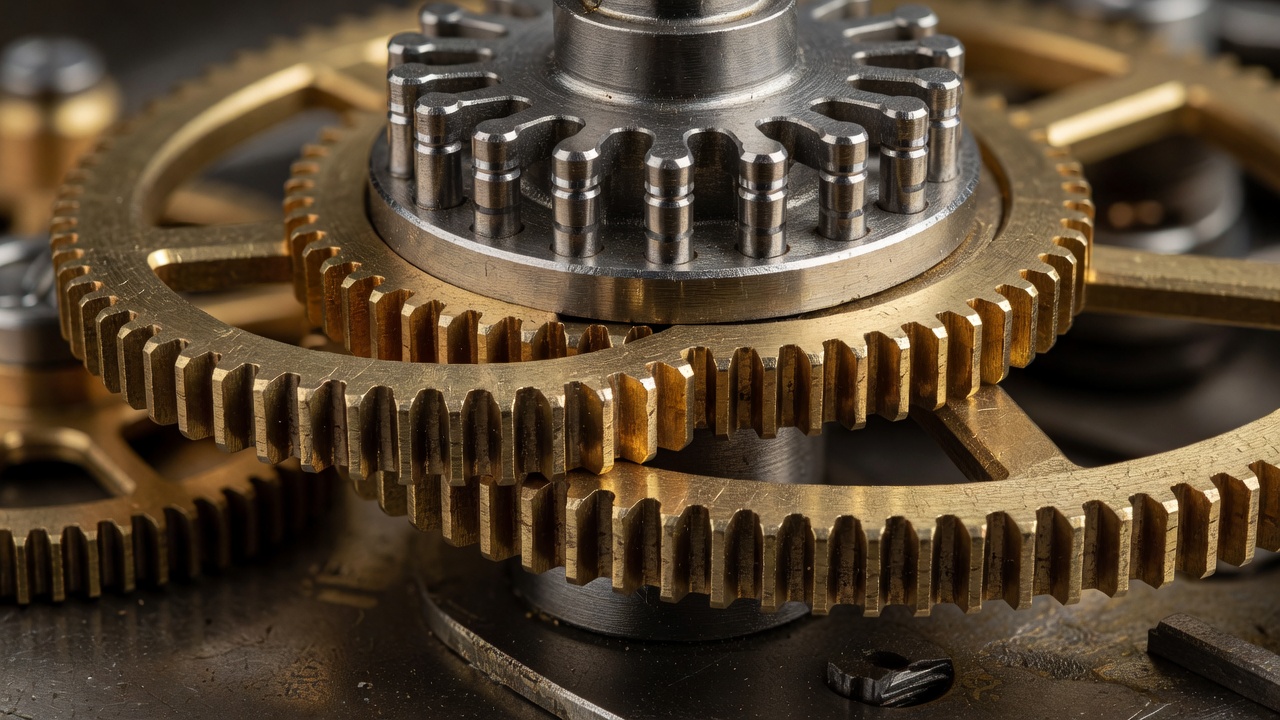
Reading pivot holes and directional drift
The cylindrical bearings — known as bushes — that support heavy steel arbors rarely wear concentrically. On the going train of a nineteenth-century flatbed clock by makers such as Thwaites & Reed or John Smith & Sons of Derby, the heaviest radial wear points along the resultant vector of driving-weight tension and tooth thrust. By sketching the direction of oval enlargement around each pivot hole before pulling the frame apart, an examiner discovers whether the tower floor has tilted, whether an earlier repairer altered the line of weight descent, or whether a replacement pinion was cut slightly oversize.
Equally telling are the steel pivots themselves. A mirror-bright groove cut deep into a hardened steel journal indicates dry running combined with silica dust drawn through unglazed tower louvres. Conversely, a dull grey, slightly pitted surface around the oil sink often points to acidic degradation from animal-derived tallow or neat’s-foot oils used prior to modern synthetic lubricants. Distinguishing mechanical abrasion from chemical corrosion determines whether a pivot can be burnished smooth or requires careful sleaving.
Teeth, pinions, and earlier compromises
Looking squarely across the flanks of cast-brass wheels reveals how earlier smiths solved crises with limited tools. In older wrought-iron movements comparable to the medieval frames preserved at Salisbury Cathedral and Wells Cathedral, individual damaged teeth were sometimes dovetailed into the rim and pinned with soft brass rivets. Later Victorian workshops occasionally “topped” worn teeth by filing the tips down or peening metal sideways to narrow excessive backlash.
These alterations are not mere flaws to erase. A dovetailed repair executed in 1820 tells the custodian how local blacksmiths kept civic time running long before standardized milling cutters existed. Under the Burra Charter principle of doing as much as necessary and as little as possible, documenting these historic interventions prevents modern machining from stripping away authentic craft evidence.
“Wear is not random noise; it is the vector diagram of every force that acted on the movement while nobody was watching.”
Witness marks, punch stamps, and paint layers
Workshop fitters routinely marked mating parts with centre-punch dots, roman numerals scribed near pinion leaves, or small file nicks along frame spacers so a disassembled train could be reassembled in exact tooth-to-leaf registry. Raking LED inspection light held at a shallow fifteen-degree angle brings out faint layout arcs compass-scribed onto wheel spokes when makers divided teeth by hand, as described in F.J. Britten’s classic surveys of early clockmakers.
Paint flakes on cast-iron frames offer a parallel archive. Cross-sections along bolted brackets often show original lead-oxide primer beneath dark Brunswick green, Victorian Prussian-toned slate, or mid-century municipal grey. Scraping an entire frame back to bare bright metal with wire wheels eliminates both protective patina and historic finish stratigraphy.
| Surface Evidence | Immediate Observation | Probable Mechanism / History | Preservation Action |
|---|---|---|---|
| Dovetail brass insert on rim | Different alloy hue & peened joint | Pre-industrial field tooth replacement | Photograph, retain intact if mesh is sound |
| Dark gritty paste in oil sinks | Coarse black grease around pivots | Airborne masonry dust mixed with grease | Sample residue before solvent cleaning |
| Scribed compass arcs on wheel | Concentric scratch at root circle | Hand-divided wheel blank layout mark | Do not buff or abrasively polish face |
| Flaked oxide under bolt heads | Layered rust pushing iron apart | Condensation & dissimilar-metal crevice | Measure movement clearance, stabilize dry |
Evidence versus assumption in the clock room
A rigorous survey note always separates raw observation from interpretation. Writing “third wheel arbor exhibits 0.9 mm vertical play in front bush” states an indisputable measurement; writing “clock stopped because of poor nineteenth-century repair” introduces an unverified narrative. Maintaining that discipline keeps condition reports useful to future conservators long after current personnel change.
Once physical wear has been mapped across the frame, the next logical task is understanding how power actually flows through those worn components. That mechanical path is traced in Dossier II: Following the train.