Repair with restraint
Unlike painted altarpieces or marble busts, monumental clocks are expected by communities to perform an ongoing functional role: showing accurate public time and sounding the hours. That dual identity creates permanent tension between horological engineering, which naturally seeks smooth modern tolerances, and heritage conservation, which insists on preserving original material even when it looks imperfect.
The principle of proportionate intervention
Guidance published by ChurchCare, the Clockmakers’ Company, and ICON emphasizes that “restoration” — returning an object to a presumed earlier pristine appearance — frequently destroys more history than decades of neglect. When a cast-iron frame carries slight surface patina and legible gold-leaf pin-striping from 1897, bead-blasting it down to bare grey iron erases authentic workshop craftsmanship solely for visual uniformity.
Instead, proportionate conservation intervenes only where mechanical failure or active corrosion threatens the clock’s stability. If a gear wheel retains intact driving flanks despite slight surface oxidation, gentle cleaning with inert microcrystalline wax protection preserves original brass far better than lathe skimming.
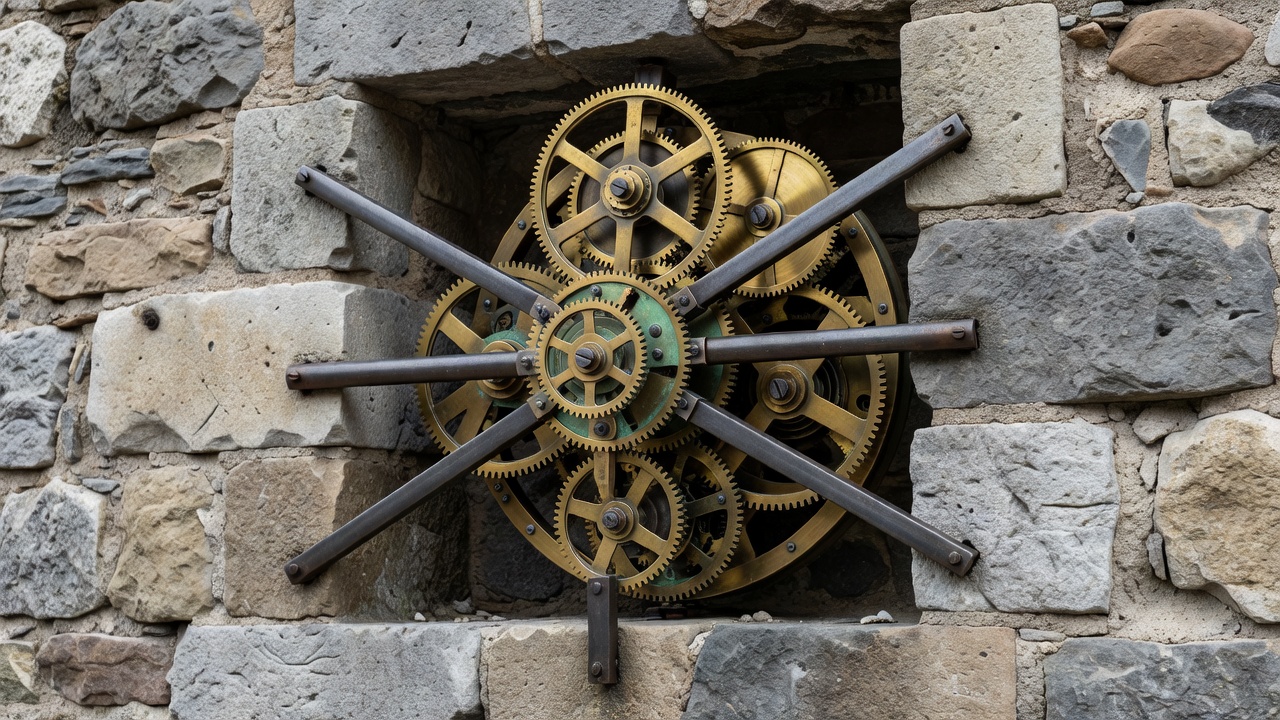
Bushing, burnishing, and sacrificial replacement
In bearing repairs, bronze or brass bushes have always been treated as sacrificial wear surfaces designed to spare harder steel pivots. Re-bushing an ovaled hole restores true centre distance between wheel and pinion — provided the repairer locates the original centre rather than reaming along the worn ellipse. Whenever a bush is pressed in, the old metal removed should be logged, and any stamped frame numbers adjacent to the hole left unblemished.
When steel pivots themselves are deeply scored, modern conservation prefers light burnishing on a Jacot tool or, where strength permits, pressing a thin hardened steel sleeve over the reduced journal rather than drilling out an original integral arbor to fit an oversized plug. Should a fractured tooth require replacement, fitting a mechanically pinned dovetail insert clearly stamped with the year of repair honours both traditional craft and modern material honesty.
Electrification and synchronous drive dilemmas
Few subjects divide tower custodians more sharply than replacing traditional weight drops with electric motors. Two fundamentally different interventions are often confused under the single label “electrification”:
| Intervention Type | Effect on Original Fabric | Reversibility | Conservation Assessment |
|---|---|---|---|
| External clamp-on autowinder on existing pulley drop | Preserves pendulum, escapement, and hand-winding gears intact | High; unbolts without frame alteration | Acceptable where daily manual winding is impossible |
| Synchronous motor replacing going-train barrel & pendulum | Discards or bypasses core historical timekeeping assembly | Low; original arbors often cut or removed | Discouraged on significant historic movements |
| Electromagnetic bell hammer replacing strike train | Stops mechanical striking train; leaves iron hammers idle | Moderate if bolted clear of original linkages | Acceptable only when mechanical strike endangers bells |
| Preserved manual winding with safety-checked lines | Zero alteration to mechanical architecture | Complete | Preferred standard where volunteer keepers exist |
Surface coatings and corrosion control
Monumental ironwork inside unheated stone towers faces winter condensation whenever warm damp outside air hits cold cast iron. Thick plastic-based paints trap moisture underneath, accelerating hidden pitting. Breathable oil-based enamels or traditional linseed-oil and graphite finishes allow inspection while respecting nineteenth-century workshop aesthetics.
Above all, every physical change must leave a paper trail. Without a durable record explaining which bushes were replaced or why an escapement pallet was adjusted, the next keeper will misread twenty-first-century tool marks as Victorian work. That continuity is the subject of Dossier IV: Keeping a reliable record.